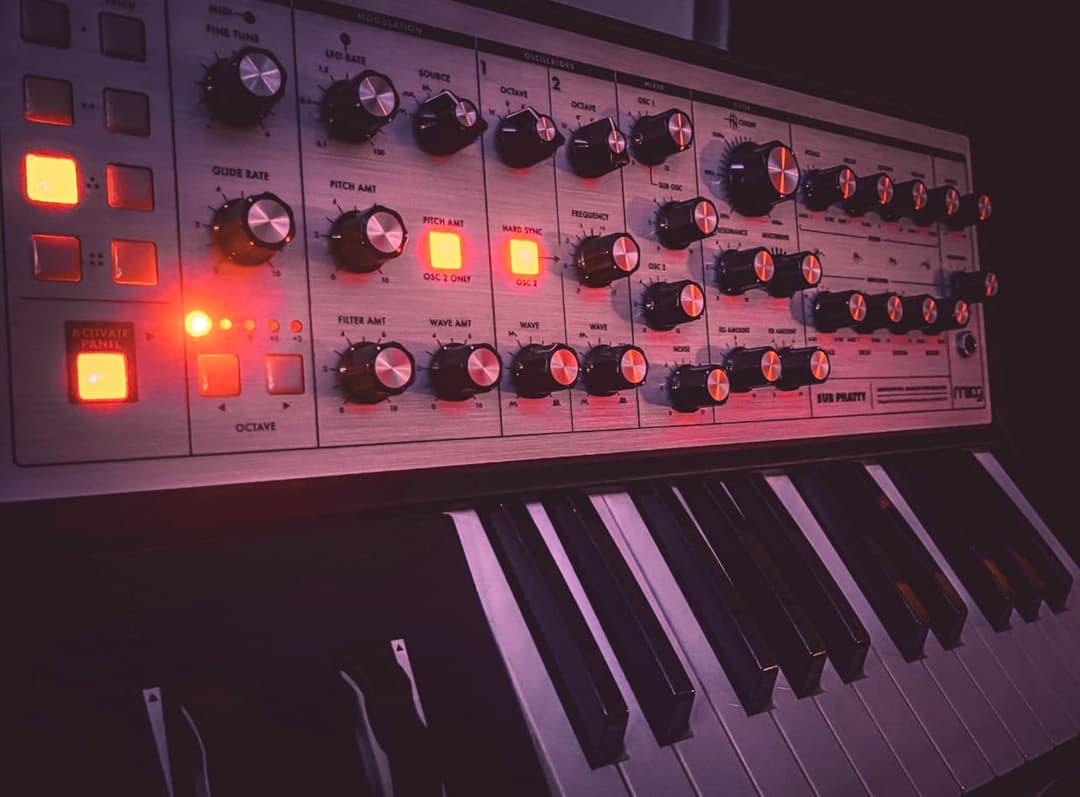
Before software instruments, a musician would save up a lot of cash to buy a particular synth/sound module (old classics like the Moog, TB303 or more recently Virus, Nord Lead, etc.). This meant that they would spend a lot of time exploring every single fader and function on that particular keyboard, tweaking every single sound on this one unit until it became a very personalized piece of equipment i.e. you designed and created sounds that you like and replaced nearly all the sounds that the manufacturers had given you.
Nowadays the abundance of Virtual Instruments means that a lot of people spend their time collecting synthesiser plug-ins without really knowing what they contain. They end up using a couple of presets and that's it. Keeping your set up simple at first and knowing how all the individual elements work will lead to you being far more creative.
A basic knowledge of synthesis can really help you shape your own sounds from simply modifying an existing preset to creating your own sounds from scratch. It is an essential tool for making electronic music.
What follows covers subtractive synthesis, the most widely used method when producing music. By the end you will understand the basic concept including the main three components of and analog’ synth (oscillator, filter, envelope). You will be able to personalise existing sounds to your needs, as well as creating new basic sounds from scratch.
What Is A Synthesiser?
A synthesiser is an electronic musical instrument. We can illustrate the difference between electronic instruments and acoustic instruments with a few examples: Acoustic instruments are all mechanical - something must be moving or resonating for sounds to be created.
- A snare drum creates a sound when hitting the skin, the drum shell amplifying the sound
- An acoustic guitar makes a sound as the player ‘strums' or ‘picks' the strings, the large hollow body resonates the sounds.
Synthesiser as used in music, is a term used to describe a device capable of generating and/or manipulating electronic signals for use in music creation.
Synthesisers as opposed to acoustic instruments don't create ‘direct' sounds, but only electric signals. Without speakers or headphones attached to the synthesiser, it will not produce any sound. This is pretty much how your CD or Mp3 player works, they don't make direct sounds either, only electric signals that are turned into sounds by your speakers or your headphones.
Synthesisers are usually equipped with a piano style keyboard which is by far the most popular input devices, but the user can also choose to use other input devices such as mouthpieces, guitar-like devices, drum pads, and of course, sequencers.
Modern synthesisers are great ‘all round' instruments as they can be made to imitate any other instrument - from wind instruments to drums.
However, another aspect of the synthesiser that we tend to maybe forget nowadays, is its possibility to create completely new and original sounds, whether you want to create ‘phat' bass sounds, lead and pads sounds or ‘weird' abstract noises. But in order to do that, you will need some basic knowledge in audio synthesis.
The complete study of audio synthesis is a science that involves electronic, physics, acoustic knowledge and more. However we will only look at synthesis from the musician point of view. The aim of the next two lessons is to give you a basic knowledge in ‘analog' synthesis, to help you manipulate and create sounds with some of the virtual sound modules available in Logic Analog VS Digital Because of the technology they used to generate sounds (Voltage controlled), one of the characteristics of analog synths was that they were not very reliable as their tuning was quite unstable (especially on earlier model), they often needed a long warm-up period and they could quickly drift slightly out of tune.
As technology advanced into the digital domain, synthesiser manufacturers began to use the new digital technology in their new designs. Pretty soon microprocessor controlled digital circuits replaced the "voltage controlled" analog circuits. The Juno 106 by Roland was an analog synth, but the oscillator was controlled digitally, making the tuning far more stable while retaining the warm sound of analog filters.
The Juno 106 by Roland, one of the last synthesisers to have sliders or knobs on its front panel, it is one of the simplest and intuitive synths to program. It also features a good MIDI implementation.
One of the most popular digital synths of the 80s was the DX7 from Yamaha, released in 1983. It featured a whole new type of synthesis called FM (Frequency Modulation). The DX-7 was entirely digital and was known for generating unique sounds, still popular to this day. The DX7 also came with MIDI, which was brand new at the time. Almost every keyboardist of the 80s bought one, making the DX-7 one of the best selling synths of all time.
Since the late 1980s most new synthesisers have been completely digital, introducing different types of synthesis and designs such as samplers for example. With the integration of MIDI and digital technology, the role of the synthesiser changed, becoming more prominent in the studio and on stage. By the late 80s, it was possible to play a full orchestration using only a few digital synths and a sequencer.
Analog revival
Digital synths offered many advantages over their analog counterparts, more versatile, more stable, instant storage and recall of sounds, size, price, etc. However, in the 90s, musicians started to realize that they were missing some of the features present in the old analog synths.
One of them was that most analog synthesisers usually had all their parameters, instantly accessible from the front panel via good old-fashioned "buttons" and "sliders". These parameters were mainly designed to program the synthesiser, but this design also allowed the player to tweak the sounds in real time while playing, thus creating special effects and evolving sounds.
If it is true that the first breed of digital synthesisers offered a whole new set of parameters to shape the sounds, thus enabling the user to create original and more complex sounds; it is also true that most early digital synths had a far less intuitive interface than their analog counterparts. The parameters were often only accessible via a menu driven operating system, and programming had to be accomplished by navigating through the various menus via buttons, a data slider and a small LCD screen. This design was not only much less user-friendly, but it also restricted the instrument's usability in ‘live' performance situations.
Many musicians also found that they preferred the warm, abstract timbres of the analog synthesisers before the sizzling, ultra precise and realistic instrument sounds of the more modern digital synthesisers. Additionally there was another factor that saw younger generation musicians turning back to analog: cost. In embracing the digital revolution of the 80’s a lot of musicians at the time dumped their old analog gear in favour of the new breed. This meant that old-fashioned analog gear was available at a knock down price and a new generation of musicians (being a skint but resourceful bunch) started buying analog synths from pawnshops and the like.
This generation were integral in creating the electronic sounds that gave birth to House and Techno and by the beginning of the 90’s the popularity of electronic music saw the first analog revival in full effect. Companies like Novation, Access and Nord brought new Synths to market that made use of the increase in computing power to create what became known as ‘Virtual Analog’ synthesisers.
By the Noughties, a lot of these synths started to be superseded by the ultimate in ‘Virtual Analog’ the VST plugin. For the first time you could use a computer to produce entirely in the box creating entire tracks without leaving the computer. The convenience and the lower cost of these plugins, coupled with the exorbitant prices that old analog gear had reached, meant that there was a real danger of analog fading into the background and become nothing more than a rich man's toy.
And there was an additional problem: VST Synths were often accused of lacking character, of being ‘Soulless’ The joy of creating sounds by tweaking knobs was being lost in a sea of mouse clicks. With the possibility of 1000’s of plugins on a computer the process of making electronic music had the potential to become laborious and preset filled, but then something has happened.
In the last couple of years there has been an explosion of new and affordable analog synthesisers that have come to market. It seems like not a week goes by without a new announcement of a shiny brand new synth. Big players like Korg seem to be driving this new revolution but there many companies including Novation & Arturia piling into the sector.
Not only that, there is a renaissance happening in the modular & DIY synth worlds where boutique companies are bring out an endless wave of the wild and the wacky and you can even by your synth in bits if that’s what you’re after. It truly is a golden age!
The concept of ‘analog' synthesis
As discussed earlier, synthesis is about the creation of sound, and the way that a sound is put together. Subtractive synthesis is essentially a three-stage process involving the same three properties, which define a ‘sound': Pitch, Tone (or timbre) and loudness (volume). In its most basic form, subtractive synthesis is a very simple process as follows: Oscillator: Used to generate a basic tone, the pitch (notes) is usually controlled with a keyboard. The basic tone is fed to a filter.
Filter: is used to shape the tonal 'colour' of the sound i.e making the sound brighter or duller. This resultant sound is fed to an amplifier.
Amplifier: Is controlled by an envelope generator (don’t worry this will be explained!) to control the volume of the sound. i.e how quickly the sound starts when a key is pressed, how loud it stays when the key is held down, and how quickly it dies away when the key is released.
This is the essence is subtractive synthesis. You start with a raw sound (oscillator), subtract out the unwanted bits (Tone shaping) and control its loudness over time, hence the name subtractive synthesis.
The reason why Subtractive synthesis is often referred to as analog synthesis is because most analog synthesisers use this method of generating sounds.
Although most new synths and virtual instruments use digital technology, the concept stays the same, which is why we still tend to call it analog synthesis.