'Bassy or trebly'- what does it mean?
In order to understand how a filter works, let's go back to the concept of frequency content.
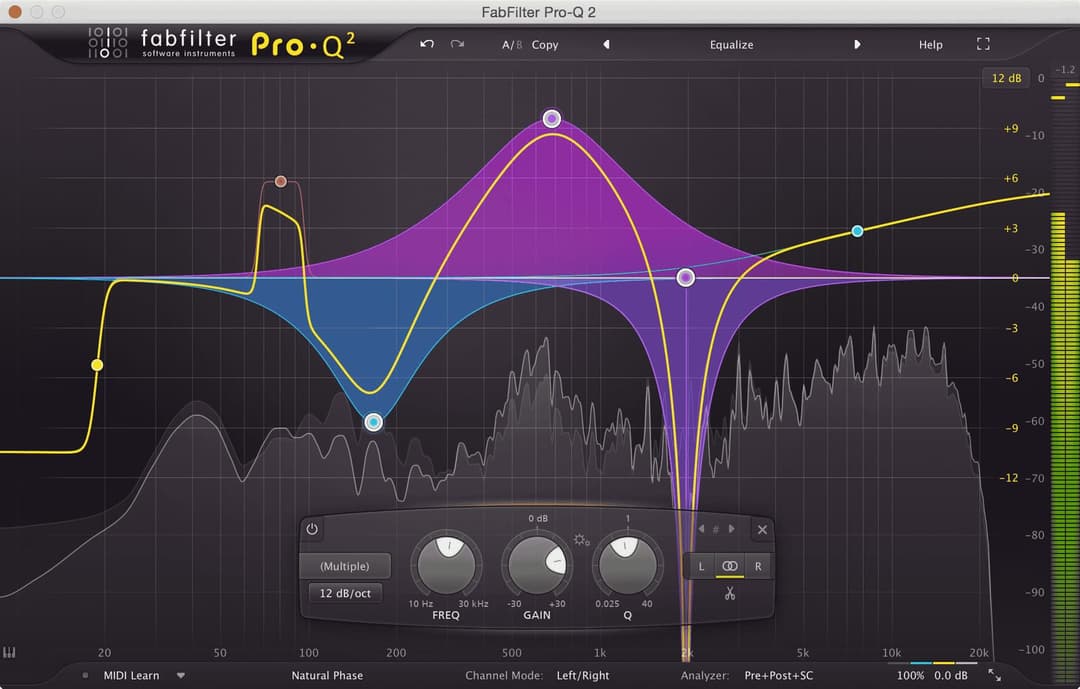
We have learned previously how a human with ‘normal' hearing capacities can hear sound ranging from 20Hz to 20kHz. The frequency content of a sound is defined by how loud the frequencies are across that range. So a 'bassy' sound is a sound that has loud low frequencies, whereas a 'trebly' sound is a sound that has loud high frequencies. Frequencies are usually categorised and represented as follow: To illustrate, let's take a look at a couple of examples.
In the picture above, the sound has loud frequencies in the lower range and nothing above 2kHz. This is a 'bassy' sound.
Here frequencies are louder in the higher range and nothing below 400Hz. This is a 'trebly' sound.
What does the filter do?
Ok so far we have our basic raw tone, and the ES2 has quite a varied selection. But we often find, we want to be able to shape the sound further, so this is where we often use a filter to change it. We have discussed how the frequency content of a sound tells us whether a sound is high or low, or if it sounds bassy or trebly.
The filter section of a synthesiser usually labelled, VCF (voltage control filter), DCF (Digital control filter) or simply Filter, is used to remove or reduce frequencies from the waveform so as to alter the tone (brighter or duller). A bit like the equalizer on your Hi-fi or TV set and quite a lot more.
The filter is a very important element in the final quality of the sound. Many 'classic' synths have achieved their status because of the quality, colour and warmth of their filter(s). The filter is not only a tool to shape the tonal aspect of a sound but also a creative tool for unique effects.
Filter types
There are various types of filters, which will of course alter the sound in different ways. We will look at some of them.
LPF- low pass filter: As its name suggests, this passes the lower frequencies while filtering out the higher ones. The point at which it starts filtering is the cutoff point determined by the cutoff control. Its general result is to reduce the high frequency content, making the sound more ‘bassy'. This is by far the most common type of filter.
HPF- high pass filter: Here again as its name suggests, this passes the higher frequencies while filtering out the lower ones. Its general result is to reduce the low frequency content, making the sound thinner.
BPF - band pass filter: The band pass filter passes a band of central frequencies while filtering/attenuating those above and below the cut off point. This filter is great to isolate a narrower frequency range.
Notch filter: The notch filter works the opposite way as the band-pass filter, it filters out the frequencies in a central band, leaving only those above and below.
Filter parameters
There are two settings, which apply to all types of filters - cut off frequency and resonance.
Cut off: It determines the frequency at which the filter starts to take effect. There is normally a knob on an analogue synthesiser to set the base cut off frequency for the filter. This base frequency can then be changed (i.e. modulated) by various controls (envelope generator, LFO, etc.) to give filter sweep effects. Sweeping the filter cut off frequency can give very dramatic effects (i.e. the constantly changing sound of an acid bassline, with the filter being slowly swept slowly up & down by an LFO).
Resonance, also known as Peak or Q: It is actually the amount of the output of the filter that is fed back into the input. Its effect is to emphasize the frequencies just around the cut off frequency. Increasing the resonance makes the filter effect more 'dramatic' - particularly with filter sweeps. On many synths, if you turn the resonance right up it feeds back on itself & turns into another oscillator.
How much filter do you need?
dB/octave: The 'strength' of a filter is measured in db/octave, dB being the volume and octave the frequencies. It represents the slope of the filter effect, how steep is the curve. In some synths this is sometimes also expressed using ‘pole'. 1 pole is 6dB reduction by octave, 2 poles 12dB/Oct, etc.