Every stereo signal can be looked at two ways. Left and right is the obvious one. Mid and side is the useful one.
Mid is what the two channels have in common — sum them and you get the centre of the image: kick, snare, bass, lead vocal. Side is what they do not — subtract one from the other and what is left is only the material that differs between the channels, which is the width.
Split a mix that way and you can treat the middle and the edges as separate things. That is the whole technique, and almost everything useful follows from it.
The three moves worth knowing
1. High-pass the sides. Low frequencies carry almost no directional information — you cannot hear where a 50 Hz tone is coming from — but stereo bass eats headroom and falls apart the moment anything sums to mono. Roll the sides off below about 120 Hz and the bottom end becomes solid and centred without you touching the kick or the bass at all.
This is the single most common professional move that never appears in a beginner's mix. Do it once and the difference is obvious.
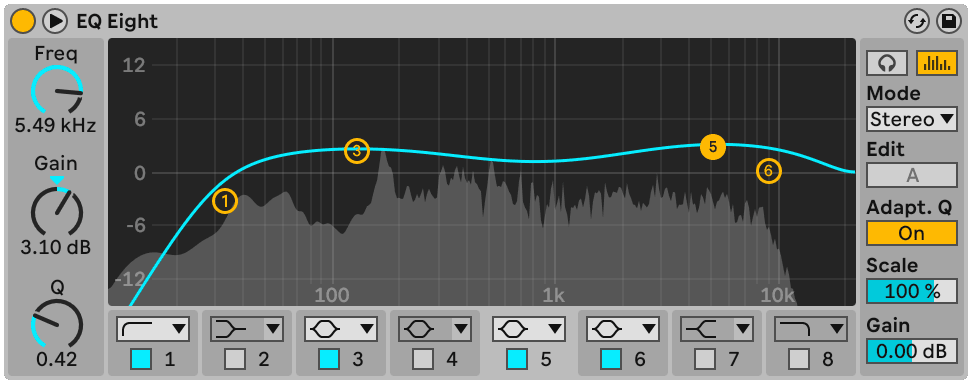
2. EQ the sides for air. A high shelf on the sides brightens everything around the vocal without brightening the vocal, so you get lift without sibilance. A high shelf on the whole mix cannot do that.
3. Compress mid and side by different amounts. Compressing the mid holds the centre steady; compressing the sides usually does the opposite of what you want, because it pulls the width in every time the mix gets loud. Most of the time: more on the mid, little or none on the side.
Where you will find it
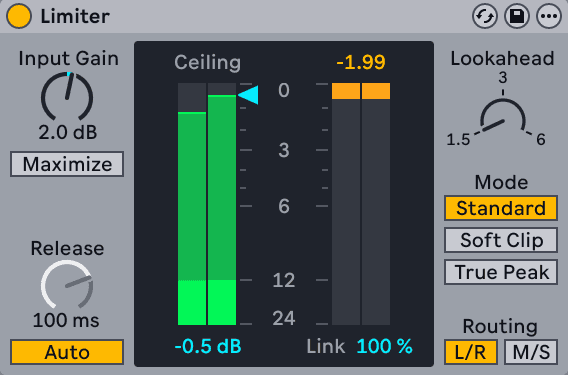
You do not need a dedicated M/S plug-in. Plenty of stock devices have it built in as a routing or mode switch — an EQ with a stereo-mode selector, a limiter with an L/R versus M/S routing choice, a delay with a mid/side option. If a device offers the switch, it can do the job.
The manual method is worth building once so you understand it: duplicate the track, flip the polarity of one side, and you have isolated the difference signal. Nobody works that way day to day, but seeing it makes the rest obvious.
The trap
Width is the easiest thing in mixing to overdo, because more of it sounds better for about ten seconds. Push the sides up and the mix seems to open out — then it collapses on a phone, in a club, on anything summing to mono, because the parts you widened were phase-cancelling material and mono removes them entirely.
Check in mono. Every time. A mono button on the master costs nothing and catches this before it ships. If something disappears in mono it was never really there.
Do this now
- Put an M/S-capable EQ on your master and switch it to side only.
- High-pass the sides at 120 Hz. Listen to the bottom end tighten.
- Add a gentle high shelf, +2 dB above 8 kHz, still on the sides only. The mix opens up and the vocal does not get harsher.
- Now hit mono and check nothing important vanished.
- Put a limiter on the master and switch its routing between L/R and M/S. Same ceiling, different behaviour — listen to which holds the centre better.
Four moves, no new plug-ins, and a mix that translates.