Dolby Atmos is the first genuinely new delivery format in music since stereo, and most of what gets said about it is wrong. It is not surround sound. It is not "more speakers". It is a different way of describing where a sound is, and the difference matters as soon as you try to mix in it.
Objects, not channels
A stereo mix is channel-based. You decide that the guitar is 30% left, and what you are really doing is deciding how much of it goes down the left wire and how much down the right. The format stores two channels of audio, and a speaker is wired to each.
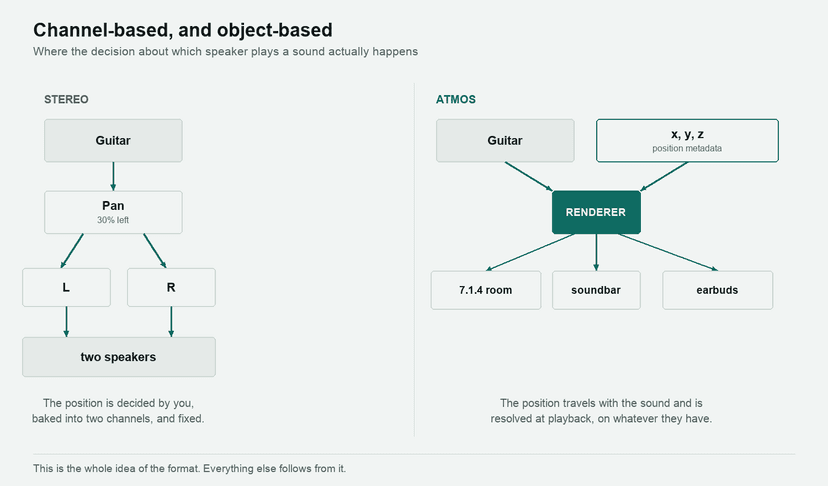
Atmos is mostly object-based. An object is a piece of audio plus metadata saying where it is — a coordinate in a room, which can move over time. Nothing decides which speaker plays it until the moment it is played back. That decision is made by a renderer, on the listener's device, using whatever they actually have.
This is the whole idea, and everything else follows from it. The same mix plays back on a twelve-speaker room, a soundbar, a car, or a pair of earbuds, and in each case the renderer works out how to put the object where you said it was.
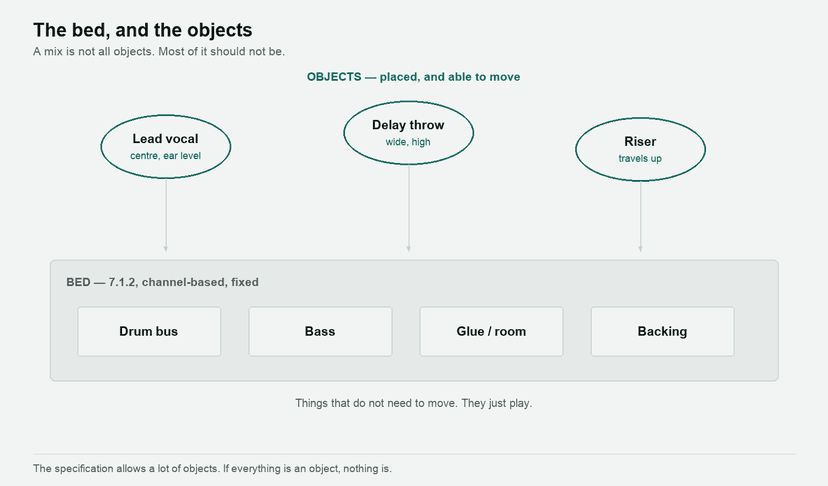
A mix is not made purely of objects, though. It has a bed as well — a channel-based foundation, normally 7.1.2, that behaves like traditional surround. Things that do not need to move live there: the drum bus, the bass, the glue. Objects are for what benefits from being placed: the lead vocal, a delay throw, a riser that travels.
The specification allows a lot of objects. Music mixes rarely use many. If everything is an object, nothing is.
The room you probably do not have
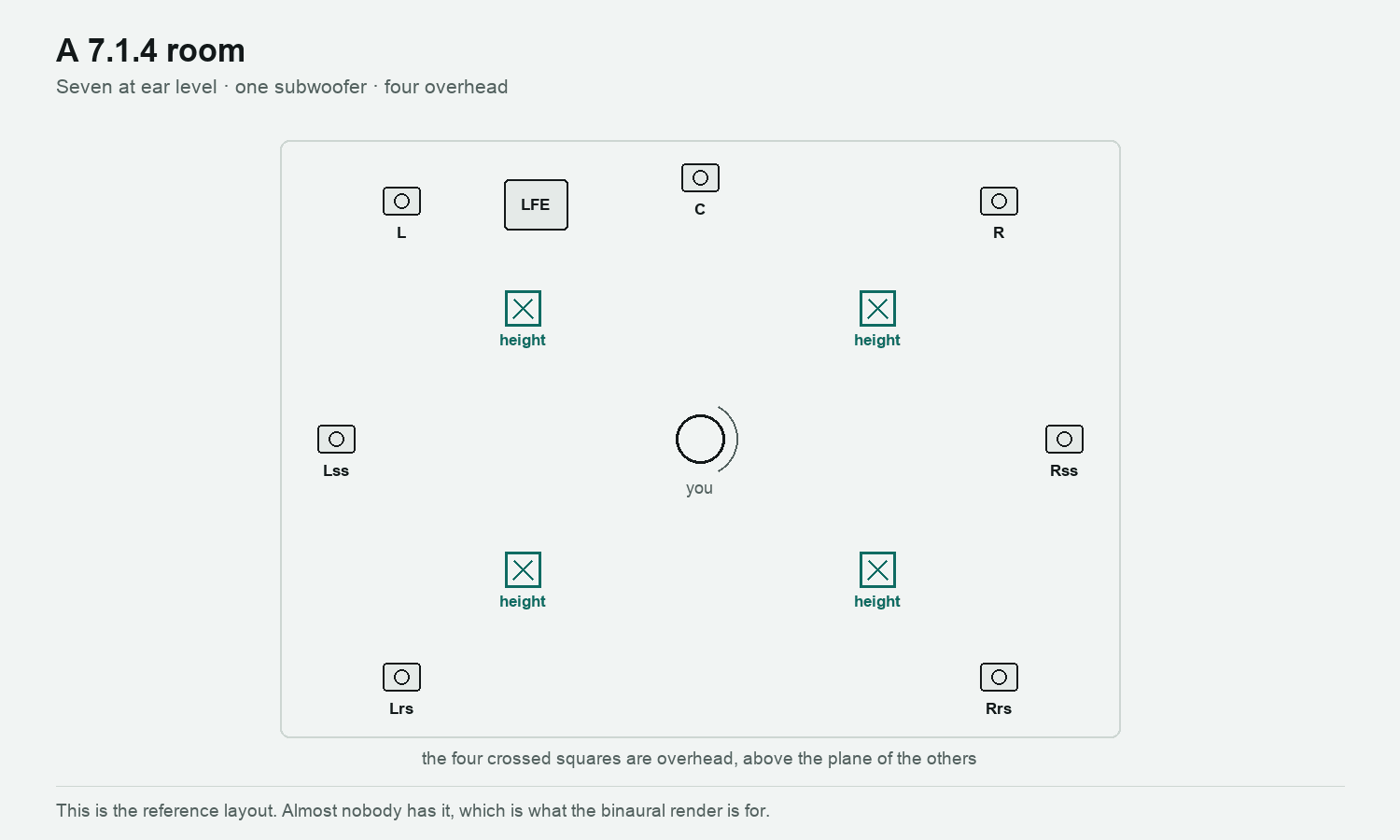
A reference Atmos room is 7.1.4: seven speakers at ear level, one subwoofer, and four overhead. That is the layout the format is designed around and the one a certified studio will have.
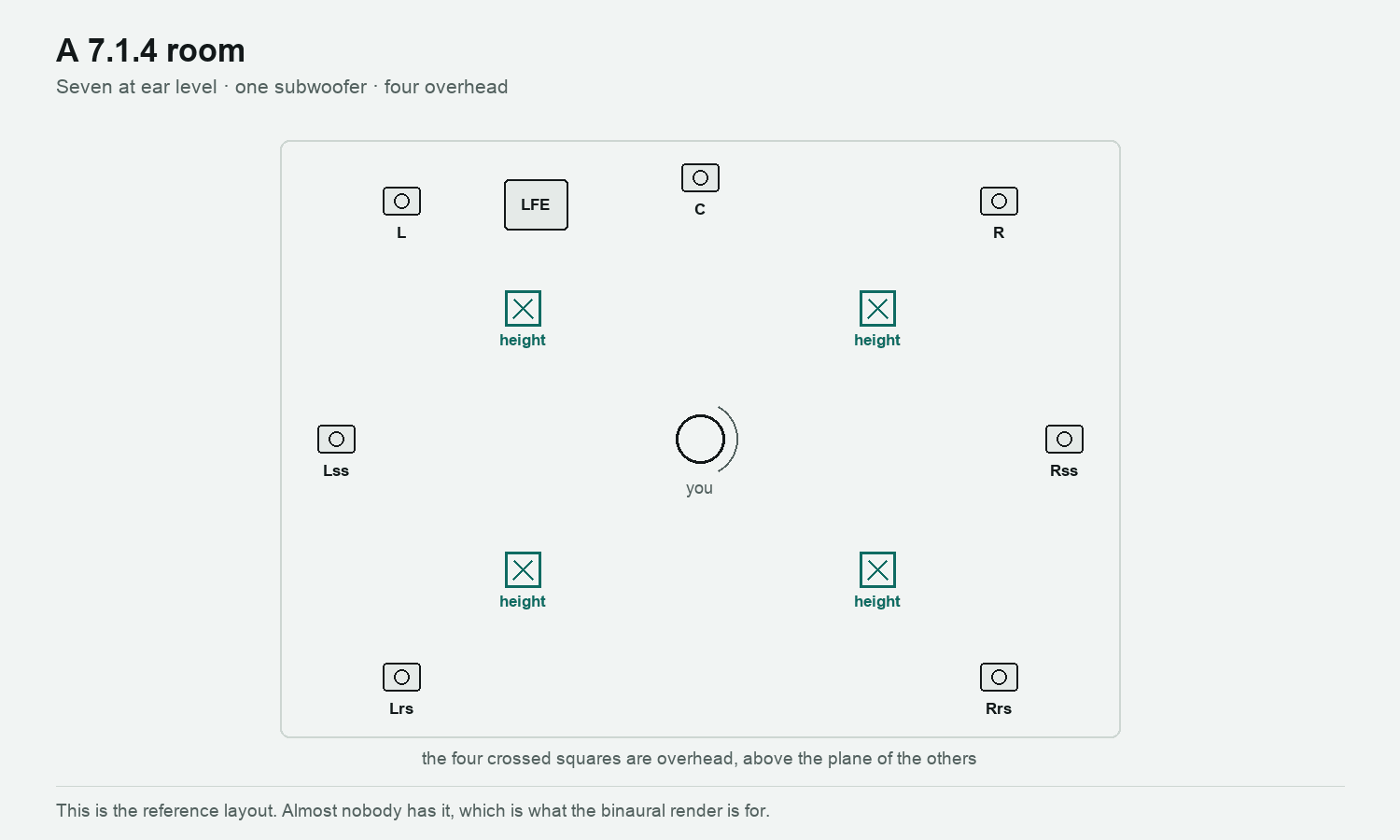
Almost nobody has it, which is where the renderer's binaural render comes in. It folds the whole three-dimensional mix down to two channels for headphones, using head-related transfer functions to simulate where each object would be. You monitor on headphones and hear an approximation of the room.
The renderer gives you control over how much of that simulation each object gets — typically off, near, mid and far. Off keeps an object in your head, which is often right for a lead vocal; far pushes it out into the simulated room, which is right for reverb returns and atmospheres.
Be honest about what this is. An HRTF is a model of an average head, and your head is not average. A binaural render is a good working reference and not the same as hearing the mix in a room. If a record matters, get it checked in a proper room before it ships.
Loudness: the one genuinely good thing
Atmos music delivery is loudness-normalised at a fixed target, and the platforms enforce it. Apple Music's Atmos specification is −18 LUFS integrated, measured from the downmix rather than from the full speaker array.
Read that again, because of what it means: you cannot win by being louder. There is no advantage to crushing an Atmos mix, because the platform will simply turn it down to the same place as everyone else's, and all you will have lost is your dynamics.
The loudness war ended in stereo streaming for the same reason, but in Atmos it was never possible to begin with. Whatever else you think of the format, it removed one of the worst incentives in the history of recorded music.
Targets do move, and platforms publish their own. Check the current specification before you deliver rather than trusting a number in a course note — including this one.
What actually changes about mixing
Height is the novelty and the easiest thing to overdo. The first instinct on hearing an Atmos system is to put something above the listener because you can. Resist it for a while. Height works best for things that are genuinely ambient — room mics, reverb returns, pads, crowd noise — and sounds like a gimmick on anything the listener is meant to follow.
Masking becomes a placement problem rather than an EQ problem. Two synths fighting over 2 kHz in stereo get solved with EQ, because there is nowhere else to put them. In Atmos you can move one of them, and the fight stops without either being changed. This is the single biggest practical gain of the format.
Reverb changes job. In stereo, reverb is how you create the illusion of space. In Atmos you have actual space, so reverb goes back to being about the character of a room rather than the existence of one. A reverb return placed above and behind the listener does something no stereo reverb can, and it does not need to be loud to work.
The centre is real. Stereo has no centre speaker — a centred vocal is a phantom image produced by both speakers. In Atmos there is a centre channel, and a vocal placed there is genuinely anchored. It is the most immediately convincing thing about a good Atmos mix.
Movement is available and mostly a trap. Objects can travel. Occasionally that is the point. Usually a moving element is distracting, and the reason it impresses in a demo is that demos are short.
What does not change at all
Arrangement. Performance. Whether the parts belong together. Whether the low end is controlled. Whether the vocal sits.
A mix that does not work in stereo will not be rescued by more places to put it. Everything in the eighteen chapters before this one still applies, and the engineers who are good at Atmos are, without exception, engineers who were already good at stereo.
Delivering it
The master is an ADM BWF file: a single .wav that carries every bed channel, every object, and all the positional metadata together. That is what you send, and it is the one file the platform needs.
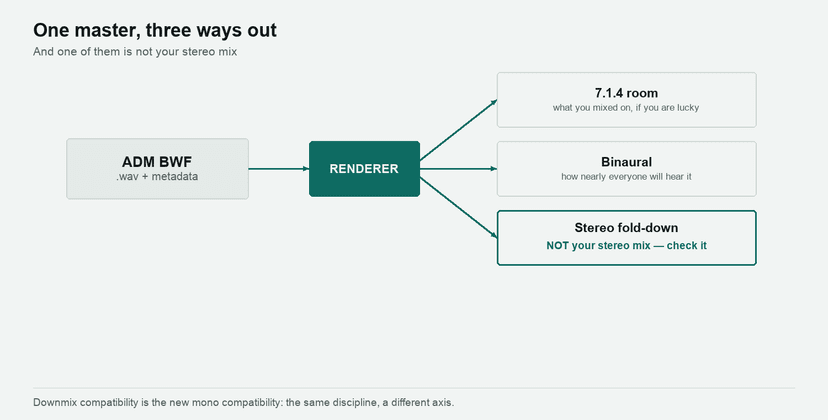
You will also deliver a stereo version, and this is where people get caught. The renderer can fold your Atmos mix down to stereo automatically, and that fold-down is not your stereo mix. It is a mathematical reduction of a three-dimensional mix, and it frequently sounds wrong — elements that were separated by position collapse back on top of each other, and the balance you carefully built in stereo is not the balance that comes out.
Always listen to the fold-down. Plenty of releases ship a separately mixed stereo master for exactly this reason. Downmix compatibility is the new mono compatibility: the same discipline, a different axis.
Getting started, honestly
In Logic Pro it is built in. Set the project to Dolby Atmos, the renderer appears in the mixer, each track is switched between feeding the bed and being an object, and the 3D Object Panner does the placing. Export produces the ADM BWF. There is nothing else to buy.
In Ableton Live there is no native Atmos renderer. If you work in Live, an Atmos mix means finishing it somewhere else — stems into a host that supports the format, or Dolby's own renderer alongside. Worth knowing before you promise anyone a spatial mix.
If you want to hear what the format does before committing to any of it, listen to a well-regarded Atmos mix on a pair of AirPods, then the stereo version of the same record, and switch between them a few times. Everything above will make more sense in five minutes of that than in another thousand words here.
So is it worth learning?
Commercially, it is no longer optional at the top end — major label releases are routinely delivered in Atmos, and the platforms pay it forward in discovery. If you intend to work on records, you will meet it.
For your own music, the honest answer is: not yet, and not first. Get stereo mixes that translate. Learn where things sit, why they mask, how to ride a vocal. Then come back to this, because every one of those skills transfers and none of the Atmos-specific ones work without them.
Do this now
- Open a Dolby Atmos project in Logic and put one element - a delay throw, a pad - on an object rather than a bed.
- Move it in the panner while it plays, and listen on headphones with the binaural render on.
- Then listen to the stereo down-mix and check nothing important disappeared.
The down-mix check is the job. Almost everyone who will ever hear your track is hearing that.