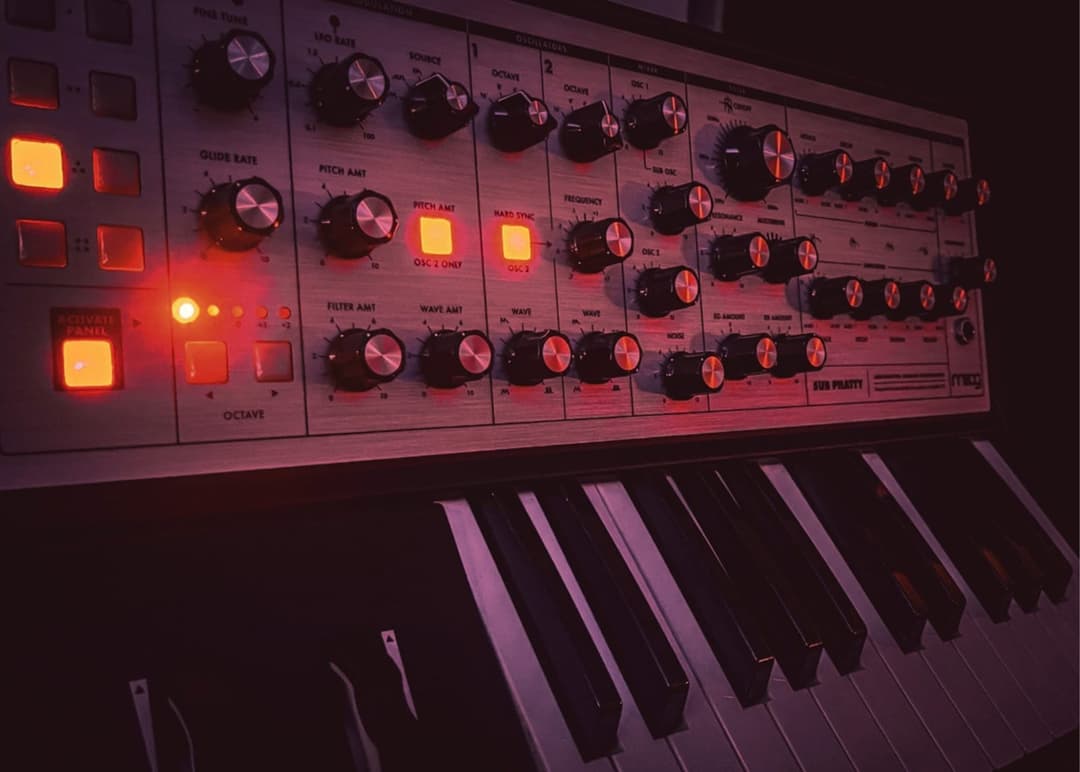
LFO LFO stands for Low-Frequency Oscillator, which is a type of oscillator used to generate a repeating waveform at a low frequency, typically below the range of human hearing.
They are used to modulate other parameters of a sound or musical composition, such as pitch, volume, filter cutoff, or pan position. By using an LFO to modulate a parameter, the parameter value is made to oscillate or change rhythmically over time. For example, an LFO can be used to create a vibrato effect on a synthesizer or to add a pulsing effect to a bassline.
LFOs typically generate simple waveforms such as sine, triangle, sawtooth, or square waves, and their rate or frequency can be adjusted to create different rhythmic patterns. Some also allow the user to adjust the waveform shape or phase, adding further versatility to their sound design capabilities.
They are a powerful tool for sound designers and music producers, providing a means to add movement and expression to a sound or musical composition. They can be used to create subtle or dramatic effects, and are commonly found in synthesizers, effects processors, and other electronic music equipment.
Polyphony Polyphony is a term used in music and sound design to describe the number of individual notes or voices that can be played simultaneously in a musical composition or sound design project. It's a measure of the complexity and richness of a musical texture, and it is an important consideration when selecting instruments or synthesizers for a project.
A monophonic instrument or synthesizer can only play a single note at a time, whereas a polyphonic instrument or synthesizer can play multiple notes or voices simultaneously. The number of voices available in a polyphonic instrument or synthesizer is often referred to as its "polyphony count," and it can range from just a few voices to hundreds or even thousands of voices in some digital synthesizers.
The ability to play multiple notes or voices simultaneously is particularly important in genres such as classical music, where multiple instruments and voices are often playing at the same time. It is also important in modern music genres such as electronic music, where polyphonic synthesizers and samplers are used to create complex and layered sounds.
Polyphony is an important consideration for sound designers and music producers, as it affects the complexity and richness of the sounds and compositions they create. The choice of polyphonic or monophonic instruments or synthesizers depends on the specific needs of the project and the desired musical texture.
Unison Unison is a term used to describe the technique of layering multiple identical or slightly detuned voices to create a thicker, richer sound. Unison is commonly used in synthesizers and other electronic instruments to create a more powerful and complex sound, particularly for lead or bass parts.
When using the unison technique, the same note or sound is played simultaneously by multiple voices, often with slight variations in pitch, timing, or timbre. This creates a thicker, fuller sound that can be used to add depth and richness to a sound or musical composition.
In some synthesizers, unison can be adjusted to control the number of voices, detune amount, and other parameters, allowing for a range of different timbres and textures. Unison can also be combined with other effects such as chorus, delay, or reverb to create even more complex and interesting sounds.
Glide Glide, also known as portamento, is a musical effect that is commonly used in synthesizers and other electronic instruments to create smooth, sliding transitions between two or more notes.
When glide is applied to a sound, it allows the notes to slide smoothly and seamlessly from one pitch to another, rather than jumping abruptly from one note to the next. The speed or rate of the glide can be adjusted to control the length of the transition, and some synthesizers also allow for the depth or intensity of the glide to be adjusted.
Glide is particularly useful for creating expressive and emotive sounds, such as in lead lines or solo parts. It can also be used to create interesting and unexpected sounds when combined with other effects such as reverb, delay, or modulation.