Every Wavetable oscillator has an effect built into it, before the signal ever reaches the filter. These are not effects in the pedal sense — they change the waveform at the source, which is why they sound so much more drastic than the same thing done afterwards.
Pick one from the chooser under each oscillator. You get one per oscillator, and the two controls next to it do all the work.
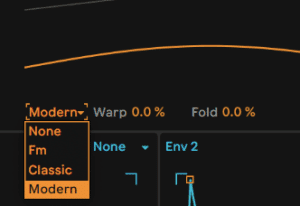
FM
The same frequency modulation as Operator, packed into one oscillator: your wavetable is the carrier, and a hidden sine wave modulates it. Tune sets the ratio, Amount sets the index.
Try it: set Oscillator 1 to a plain Basics table, add FM, and turn Amount up slowly while moving Tune through whole numbers. Whole-number ratios stay musical. Everything between them goes metallic and bell-like, which is exactly what you want for a bell.

Pulse Width and Sync
Pulse Width is the classic subtractive trick — vary the width of a square wave and the harmonic content shifts. Modulate it with an LFO and a static chord starts breathing.
Sync resets one oscillator's phase to another's, which forces harmonics that were never in the waveform. It is aggressive, cutting and unmistakable — the hard-edged lead sound. Sweep the Amount with an envelope and you get the classic sync sweep.

Phase Distortion: Fold and Warp
This is the modern one, and the one worth spending time on.
Fold adds harmonics by folding the waveform back on itself when it exceeds its own limits. Turn it up on a sine and watch a pure tone grow teeth.
Warp speeds up the readout of the waveform through part of its cycle and slows it through the rest — the same idea as warping an audio clip, applied to a single cycle. It is where the hard, aggressive timbres in modern electronic music come from. Dubstep basses live here.

Do this now
- Load Wavetable, Oscillator 1 on a Basics saw.
- Add Phase Distortion and push Fold to about halfway. Already nastier.
- Assign an LFO to Warp in the Modulation Matrix, sync it to 1/8, amount around 30%.
- Play one long low note. It will not sit still.
- Now put a filter after it and automate the cutoff. That is a bass patch, built in four moves and no presets.