Sub: Waveforms and Harmonics, Sine Waves
Sound is a vibration travelling through a solid, a liquid or a gas — usually the air. Like ripples on a pond the waves spread out, hit your eardrums, and the brain hears them as sound.
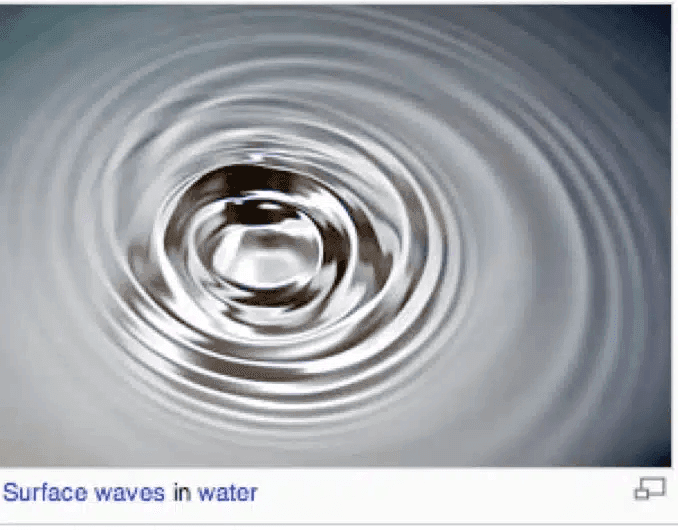
…when any mechanical collision occurs vibrations and then (sound) waves are produced.
In the course we will also study how Physical Modeling Synthesis uses this process to synthesize quasi acoustic sound
Waveforms are a timeline representation of audio signals.
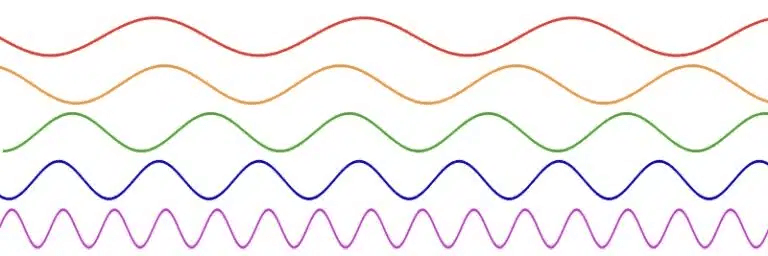
Sound is represented as waveforms of various lengths and shapes over time. The most basic waveform is the sine wave (no harmonics)
Here we see sinusoidal waves of various frequencies; the bottom waves have higher frequencies than those above The horizontal axis represents time.
To have a pitched sound the waveform has to be periodic. Noise for instance is not a periodic waveform.
The number of times a periodic waveform goes through a complete cycle in a second is called the frequency.
A frequency of 1000Hz, or 1 kHz, means that the sine wave goes through 1000 complete cycles in one second.
Some instruments, especially percussion, do not have pitch and hence are non-periodic, or aperiodic.
The higher the basic frequency of a periodic wave the higher the pitch of the sound produced.
Generally a single sound will include a fundamental frequency (the pitch or note you play) and any number of overtones, harmonics or inharmonics.
The higher the fundamental frequency of a wave the higher the pitch of the sound produced.
Harmonics
A harmonic is a sine wave with a frequency that is a whole-number multiple of the fundamental frequency or pitch. In other words, a harmonic is a wave that has a frequency that is a whole number times the frequency of the fundamental (pitch) wave. The fundamental frequency is the lowest frequency component of a waveform. The higher frequencies are called harmonics. The ratio of the fundamental frequency to the first harmonic is 1:1, the ratio of the fundamental frequency to the second harmonic is 2:1, and so on.
Harmonics can be either odd or even.
For example, if the fundamental frequency (first harmonic) is 440 Hz, then the 2nd harmonic is 880 Hz, the third harmonic is 1320 Hz, and so on.
The original signal is also called the 1st harmonic, the other harmonics are known as higher harmonics. As all harmonics are periodic at the fundamental frequency, the sum of harmonics is also periodic at that frequency. The set of harmonics forms a harmonic series.
The Timbre of a sound is determined by the relative volumes of its harmonics and overtones.
The presence of harmonics is what gives sound its characteristic timbre. The timbre of a sound is the quality that allows us to distinguish between different instruments, even when they are playing the same note. For example, a violin and a trumpet may both be playing
the note C, but they will sound different because of the different harmonics present.
Plenty of sounds have overtones that are not whole-number multiples of the fundamental — inharmonics — and those sounds have less of a clear tonal or melodic character. Inharmonics nowhere near a harmonic are called partials, and they push a sound towards dissonance. Well-made conventional instruments are built so their notes do not throw up dissonant overtones. Bells are the obvious exception: their partials are strongly inharmonic, and that is the sound of a bell.
Manipulating the harmonics of a sound can significantly alter its timbre and character. Adding or emphasizing certain harmonics can make a sound brighter, more aggressive, or more complex. Removing or reducing certain harmonics can make a sound duller, softer, or more mellow. Understanding and manipulating harmonics is an important part of sound design, as it allows us to create a wide range of unique and interesting sounds. By experimenting with different harmonics and their relative amplitudes, we can create sounds that are rich, complex, and expressive.
The harmonic make up of a sound can be seen with a spectrum analyzer (Ableton>Utilities). It shows all the harmonics present with their specific volumes in the frequency domain.
The basic concept of spectral analysis of complex tones is contained in Fourier’s Theorem which states that any periodic waveform is composed of a superposition of pure sine waves, with specific amplitudes and phases, whose frequencies are harmonics (integer multiples) of the fundamental frequency of the sound..
Waveform and the Spectrum are just two different ways of seeing the same thing.
So basically we have two ways of viewing sounds; the time domain shows the waveform and the frequency domain shows the harmonic spectrum. To view waveforms in real time we can use an oscilloscope.
For the SD classes I recommend that you download this free M4L oscilloscope:
http://maxforlive.com/library/device/1918/jo-floating-oscilloscope
Change some of the overtone frequencies and you will also see the waveform change. We will see this in real time when we do Additive Synthesis with Ableton’s Operator where we can draw harmonics into the spectrum.
Additive synthesis generates a series of sine waves, with appropriate pitches and levels over time, for each harmonic. We will see this in real time when we do Additive Synthesis with Ableton’s Operator where we can draw harmonics into the spectrum.
Additive synthesis generates a series of sine waves, with appropriate pitches and levels over time, for each harmoni
Waveforms are an essential tool for sound designers, providing a means to both create and analyze sounds. By understanding the characteristics and properties of different types of waveforms, we can create a wide range of sounds, and manipulate existing audio in creative ways. Looking at waveforms we can also adjust the timing (Phase) of specific sounds within a mix, and with some experience identify the overall character and timbre of a sound at a glance..
Basic Waveforms
They are the sound sources present in the oscillators of most classic vintage analog hardware synths and their digital emulations, such as Ableton’s Analog.
Sine Wave
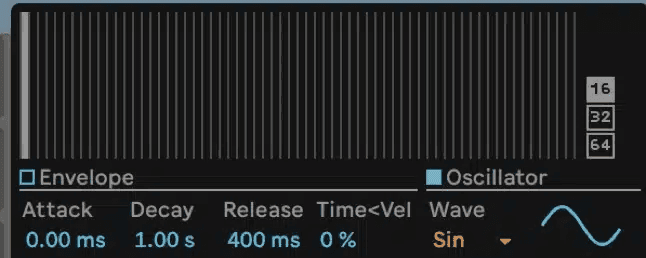
This is the simplest basic waveform with no higher harmonics or other overtones
It is a periodic waveform that has a smooth and repetitive oscillation, characterized by a consistent amplitude and frequency. The shape of a sine wave resembles a smooth and continuous curve, with no abrupt changes. It is containing only a single frequency component, which is known as the fundamental frequency.
Low sine waves are ideal to add sub bass to to a bass or bass drum. You can synthesize a perfect 808 kick using a sine!
The sine wave is also a fundamental waveform that is used as a basis for other types of waveforms and several synthesis methods.
Sine waves are commonly used in classic FM Synthesis, where you can synthesize just about any complex waveform or spectrum out of
a combination of modulating sine wave. It is probably the 2nd most popular synthesis tool found in combination with other methods in any modern synth. We will look at FM Synthesis in depth when using Ableton’s Operator. They are also used for Additive Synthesis.
Since this waveform has no harmonics it’s of little use by itself with Subtractive Synthesis.
Triangle Wave
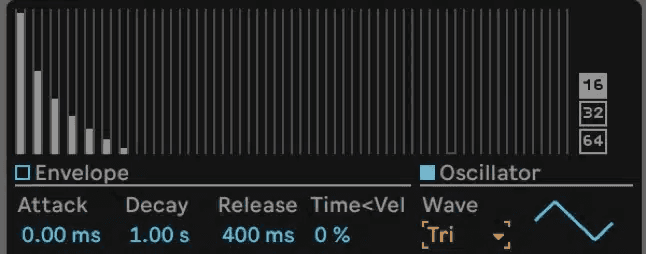
A type of periodic waveform that has a triangular shape, characterized by a linear rise in voltage followed by a linear decrease back to the baseline. The triangle wave is a simple waveform that containing only odd harmonics at differing amplitudes, making it a bit richer and brighter than a pure sine wave but way less complex than a sawtooth wave.
They are often used for bass lines, lead sounds, and other melodic elements in electronic music genres like trance, ambient, and IDM.
Sawtooth Wave
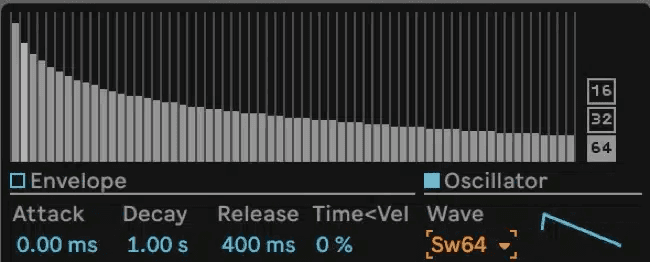
A sawtooth wave is a type of periodic waveform that has a sawtooth shape, characterized by a sharp rise in voltage followed by a gradual decrease back to the baseline. The sawtooth wave is a simple waveform that contains both odd and even harmonics, making it the richest and most complex waveform in classic analog synths. Due to it having all harmonics present, the Sawtooth is probably the most “general purpose” of all available waveforms. It’s ideal for Subtractive Synthesis, which is based on attenuating (subtracting) or boosting selected harmonics with various Filter types. We will be exploring this most popular synthesis method in depth with Analog.
Sawtooth waves are commonly used with subtractive synthesis, where they can be used to create a range of sounds, from bright and buzzy to dark and growling. They are also used in electronic music genres like techno and trance, where they are often used for bass lines, lead sounds, and other melodic elements.
Square Wave
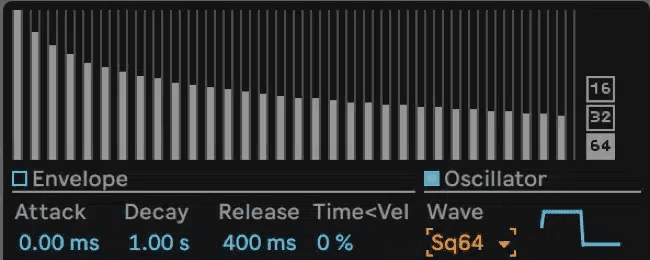
A square wave is a waveform that has a square shape and contains only the odd harmonics (3/5/7/9/etc) It alternates between two constant amplitude levels, typically high and low. The square wave is a periodic waveform, meaning that it repeats itself over time, and its frequency is determined by the rate of alternation between the high and low levels.
The square wave can also be used to create pulse width modulation (PWM). It becomes a Pulse wave with variable asymmetrical cycles.
Due to its odd harmonics, the square wave has a more complex frequency spectrum than simple waveforms like the sine wave. The amplitude of the odd harmonics decreases as the harmonic number increases, and their contribution to the overall waveform diminishes accordingly. It produces a distinctive hollow sound compared to the brighter Sawtooth and it is also very useful for filtering with Subtractive Synthesis, where specific frequency components can be removed or emphasized.
Ideal for bass sounds and also pads in combination with PWM.
Noise
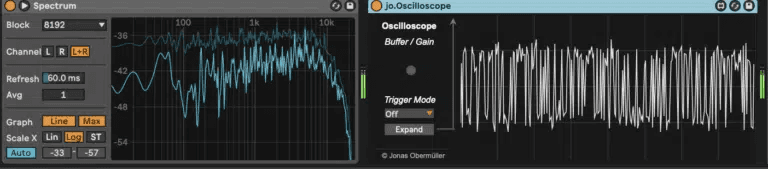
Noise, also known as random noise, is a waveform that has a random variation in amplitude over time. It is a signal that has no discernible pattern or periodicity, and its amplitude at any given time is unpredictable.
There are several types of noise waveforms, including white noise, pink noise, and brown noise. White noise is a type of noise that has an equal distribution of energy across all frequencies, resulting in a flat frequency response. Pink noise, on the other hand, has a frequency spectrum that rolls off at a rate of 3dB per octave, resulting in more energy in the lower frequencies. Brown noise has a frequency spectrum that rolls off at a rate of 6dB per octave, resulting in even more energy in the lower frequencies.
Noise waveforms are commonly used in audio synthesis and processing, where they can be added to a signal to create a sense of randomness or unpredictability. Also adding white noise to a signal can create a sense of “air” or “space” in the sound, while adding pink noise to a signal can create a sense of warmth.
Noise can also be an important component when synthesizing drum sounds such as HiHats and Snare Drums.
Do this now
- Load Analog with one oscillator and a spectrum analyser after it.
- Switch between sine, triangle, saw and square and watch the harmonics appear.
- Note which waveform has only odd harmonics, and hear what that sounds like.
Seeing the spectrum change as you switch waveform is worth more than any amount of reading about it.