Two techniques that cost nothing and fix the most common complaint about subtractive synthesis: that it sounds static.
Pulse Width Modulation
A square wave is on for half its cycle and off for the other half — a 50% duty cycle. Pulse width is what happens when you make that uneven: on for 30%, off for 70%. The waveform is still a square, but the harmonics change completely.
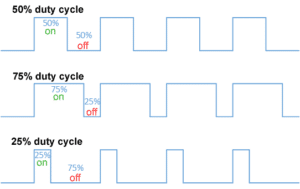
Set the width by hand and you get a different tone. Set an LFO modulating the width and you get movement — a slow, breathing thickness that sounds like two detuned oscillators but costs one. It is the sound of a string pad, and of about half the bass patches ever made.
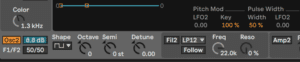
Sync the LFO to a note value and that breathing becomes rhythmic instead. Same control, different musical job.
Serial filtering
One filter shapes the sound one way. Two filters in series shape it in ways a single filter cannot reach — the output of the first feeds the input of the second, and each one keeps working on what the last one left.
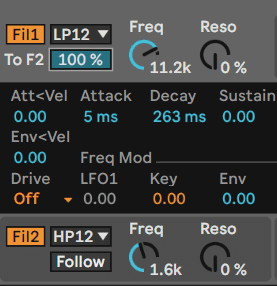
In Analog, send Filter 1 100% to Filter 2. Now put a high-pass on one and a low-pass on the other and you have a band you can move from both ends independently, with separate resonance on each. A single band-pass filter cannot do that.
Add Drive into the chain and the two filters stop being tidy: filter, then saturate, then filter again, and the second filter is now shaping harmonics the saturation created rather than ones the oscillator made.
Do this now
- Load Analog. Oscillator 1 to a square wave, everything else off.
- Set the pulse width off centre. Listen — thinner, more nasal.
- Assign LFO 1 to pulse width, rate around 0.3 Hz, a small amount. Hold a chord. It should now sound like more than one synth.
- Turn on Filter 2 and route Filter 1 into it. Low-pass on 1, high-pass on 2.
- Move both cutoffs while the chord holds. Squeeze the band until it is almost a whistle, then open it back up.
- Add Drive between them and do it again.
Two controls neither of which is exciting on its own, and between them most of what makes a subtractive patch sound alive.