LFO, Polyphony, Unison and Glide
LFO stands for Low-Frequency Oscillator, which is a type of oscillator used to generate a repeating waveform at a low frequency, typically below the range of human hearing.
They are used to modulate other parameters of a sound or musical composition, such as pitch, volume, filter cutoff, or pan position. By using an LFO to modulate a parameter, the parameter value is made to oscillate or change rhythmically over time. For example, an LFO can be used to create a vibrato effect on a synthesizer or to add a pulsing effect to a bassline.
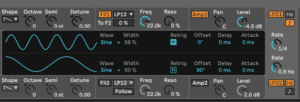
LFOs typically generate simple waveforms such as sine, triangle, sawtooth, or square waves, and their rate or frequency can be adjusted to note values and synchronized to the BPM of your track to create rhythmic patterns. Some also allow the user to adjust the waveform shape or phase. Below we see how LFO1 is synced to a 1/4 note and LFO 2 uses a 90 degree phase offset as starting point of its cycle.
Polyphony
Polyphony is a term used in music and sound design to describe the number of individual notes or voices that can be played simultaneously with an instrument. When you play a chord for instance you need multiple voices i.e. one for each note.
A monophonic instrument or synthesizer can only play a single note at a time, whereas a polyphonic instrument can play multiple notes or voices simultaneously. The number of voices needed for a polyphonic musical part is often referred to as its polyphony count, and depending on the sound and part at hand, you could be using many more voices than had been allocated by default which results in a higher CPU load.
Keeping track of the amount of voices needed is an important consideration for sound designers to make sure all notes are playing as intended!
The polyphony count also increases drastically as soon as you start using unisono voices!
Unison
Picture the same note played several times on top of each other. Normally that would only lead to a louder note. Unison is a term used to describe the technique of layering multiple identical slightly detuned, panned or delayed voices. This creates a thicker, fuller sound that can be used to add depth and richness at times comparable to a chorusing effects. Additional voices playing the same note can also be used to create a stereophonic spread for pads or more drastic, detunings for leads.
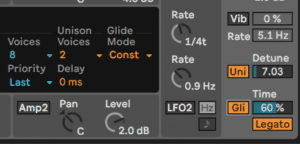
In Analog unison can be adjusted to control the number of voices, detune and delay amount, as well as for prioritizing some voices when polyphony is exceeded!
.
Glide
Glide, also known as portamento, is a musical effect that is commonly used in synthesizers and samplers to create smooth, sliding pitch transitions between two or more notes in mono mode.
When glide is applied to a sound, it allows the notes to slide smoothly and seamlessly from one pitch to another, rather than jumping abruptly from one note to the next. The speed or time of the glide can be adjusted to control the length of the transition.
Glide is particularly useful for lead lines or solo parts. The provided Legato function enables the Glide effect only for a note that extends to the beginning of the next note i.e. adjacent notes.
Do this now
- Set Analog to mono with glide and play a legato line - notes overlapping.
- Now play the same line without overlapping and hear the glide stop.
- Switch to poly, add unison voices and detune them until it thickens without going out of tune.
Legato is the control that decides when glide happens. Most people never find it.