Hybrid Reverb runs two reverb engines at once and lets you crossfade between them. That sounds like a convenience feature. It is actually the reason it sounds better than either engine on its own.
The two engines
Convolution uses an impulse response — a recording of a real space, or of a real reverb unit. It is unarguably realistic, because it is a recording of the thing. What it cannot do is change: the space is the space, and its decay time is whatever was recorded.
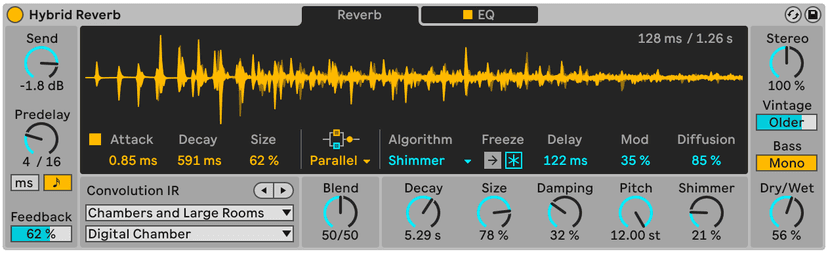
Algorithmic builds the reverb mathematically. Less convincing as a room, but every parameter is yours — decay, size, shape, damping, all adjustable in real time and automatable.
Why blending them works
Your ear identifies a space from its early reflections — the first few milliseconds, the pattern of sound bouncing off the nearest surfaces. It judges the *size* of a space from the tail.
So: convolution for the early reflections, where realism matters and you would not want to change anything. Algorithmic for the tail, where you want control over length and tone. The blend control is doing something real, not just mixing two reverbs.
- Vintage and Hall IR categories for character; the real-space IRs for realism.
- The algorithmic side has Dark Hall, Quartz, Shimmer and Tides — Shimmer and Tides are effects rather than rooms, and both are worth a listen on a pad.
- Predelay before both. On a vocal, 20–40 ms of predelay is the difference between a vocal in a room and a vocal drowning in one.
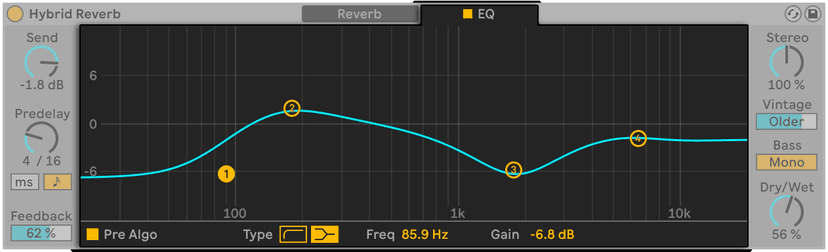
- The EQ section sits between the reverb and the output. Roll the low end off the reverb, not the source — that is how you keep a big reverb without muddying the mix.
Do this now
- Put Hybrid Reverb on a return, feed it a snare.
- Blend fully to Convolution and pick a small room IR. Listen to how the snare sits in a place.
- Blend fully to Algorithmic, Dark Hall, long decay. Bigger, less real.
- Now put the blend in the middle. That is the one.
- Add 25 ms predelay and high-pass the reverb at 300 Hz.