Grain Delay
The Grain Delay effect slices the input signal into tiny particles (grains) that are then individually delayed and can also have different pitches compared to the original signal. Randomizing pitch and delay time can create complex masses of sound and rhythm that seem to bear little relationship to the source.
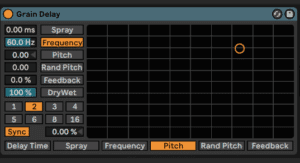
You can route each parameter to the X-Y controller’s horizontal or vertical axis. To assign a parameter to the X-axis, choose it from the parameter row below the controller. To assign a parameter to the Y-axis, use the parameter row on the left side.
To sync delay time to the song tempo, activate the Sync switch, which allows using the Delay Time beat division chooser. The numbered switches represent time delay in 16th notes. For example, selecting ”4” delays the signal by four 16th notes, which equals one beat (a quarter note) of delay. With Sync Mode active, changing the Delay Time field percentage value shortens and extends delay times by fractional amounts, thus producing the ”swing” type of timing effect found in drum machines.
If the Sync switch is off, the delay time reverts to milliseconds. To edit the delay time, click and drag up or down in the Delay Time field, or click in the field and type in a value.
The Delay Time can also be routed to the horizontal axis of the X-Y controller.
The Spray control adds random delay time changes. Low values smear the signal across time, which adds ”noisiness” to the sound. High Spray values completely break down the structure of the sound, introducing varying degrees of rhythmic chaos. This is great for sonic experimentation in combination with changing the other parameters.
Frequency controls the size and duration of each grain The sound of Pitch and Spray depends very much on this parameter.
Pitch acts much like a crude pitch shifter by letting you transpose the grain pitch.
Random Pitch adds random variations to each grain’s pitch. Low values create a sort of mutant chorusing effect, while high values can make the original source pitch completely unintelligible. This parameter can interact with the main Pitch control, thus allowing degrees of stability and instability in a sound’s pitch structure.
Feedback sets how much of the output signal returns to the delay line input. Very high values can lead to runaway feedback. Watch your ears and speakers if you decide to check out extreme feedback settings!
The dry/wet control can also be routed to the vertical axis of the X-Y controller.
Do this now
- Put Grain Delay on a vocal with Pitch at 0 and Frequency low.
- Raise the frequency until it stops being a delay and becomes a texture.
- Add Random Pitch and Spray and let the tail come apart.
Grain Delay is the cheapest granular processor in Live and the one nobody opens.