Intro to FM
FM synthesis (frequency modulation synthesis) is a method of sound synthesis that uses one or more modulating oscillators to manipulate the frequency of one or more carrier oscillators. The modulating oscillator is used to modulate the frequency of the carrier oscillator, resulting in the creation of new harmonic content.
While subtractive synthesis sculpts timbre by removing harmonics from a waveform already rich in harmonics (e.g. a saw or square wave) FM synthesis goes the inverse route, creating harmonics by simply using sine waves, that have no harmonics at all (classic FM), in a modulating configuration called Algorithm.
The timbre of a sound is created by using a modulating oscillator to modulate the frequency of a carrier oscillator. As the frequency of the modulating oscillator changes, the waveform of the carrier oscillator changes, as new harmonic content is created. By changing the frequency, amplitude, and phase of the modulating oscillator, a wide range of different sounds can be created, from simple bell-like tones to complex and evolving textures.
One of the advantages of FM is its ability to create complex and evolving sounds using a relatively simple synthesis engine. With careful parameter adjustment, sound designers and music producers can create a wide range of sounds, from warm and mellow to harsh and metallic.
FM synthesis was popularized in the 1980s with the introduction of the Yamaha DX7 synthesizer, which used FM synthesis to create a wide range of sounds, from realistic pianos and brass to experimental and avant-garde textures. Today, FM synthesis remains a popular method of sound synthesis, used in both hardware and software synthesizers, as well as in sound design and audio production more broadly.
The Ratio between the modulating oscillator and the carrier oscillator determines the type of harmonics that are produced when increasing the modulation amount also referred to as Index. Index refers to the volume of the modulation signal that is applied to the carrier frequency.
Ratios (Operator’s Course) are integer multiples of the note played, i.e. 1 is the note you play, 2 is an octave 3 is 3 times the note (fifth), 4 another octave and so on representing a harmonic series.
Fine(offset) tunings can create subtle movement and beating effects or clangorous inharmonics.
The index determines how many of the possible harmonics based on the C:M Ratio will be created
The index is typically represented as a numeric value of the volume of the modulator, whereby the carrier volume is the volume that is appearing at the mixer.
Sidebands refer to the additional frequency components that are produced when a signal is modulated by another signal. In the context of FM (frequency modulation) synthesis, sidebands are the additional frequency components that are produced when a modulating signal is applied to a carrier signal.
They are created when the modulating signal causes the frequency of the carrier signal to deviate from its original frequency. As a result, new frequencies are produced that are offset from the original carrier frequency by the frequency of the modulating signal. These new frequencies are known as sidebands and are positioned above and below the carrier frequency in the frequency spectrum.
The number and intensity of the sidebands depend on the strength of the modulating signal. As the modulation depth (i.e., the degree to which the carrier frequency is modulated) increases, the number and intensity of the sidebands also increase, resulting in a more complex and harmonically rich sound.
By adjusting the frequency and intensity of the modulating signal, sound designers and music producers can create a wide range of sounds, from smooth and mellow to harsh and metallic textures.
Control Rate & Audiorate
In the context of sound synthesis, control rate and audio rate refer to the rate at which signals are processed by a synthesizer.
Control rate, also known as the modulation rate, is the rate at which control signals, such as envelopes, LFOs (low-frequency oscillators), and other modulators, are processed by a synthesizer. Control rate signals typically have a much lower frequency range than audio signals, typically ranging from a few hertz up to max 20 hz.
Audio rate, as the name suggests, is the rate at which audio signals are processed by a synthesizer. Audio rate signals typically have a much higher frequency range than control rate signals, ranging from around 20 Hz to 20 kHz, which covers the range of human hearing.
With FM, we’re using audio rate signals to create the harmonics by modulating the carrier frequency.
FM Theory Basics Tutorial: Using CM Ratios to Calculate Sidebands and Harmonics
Even though classic FM was done only with sine waves we have many more waveforms to pull from in Operator. Some are Waveforms that could be recreated in similar ways by just using sine waves with certain CM ratios. Any time spent here reflecting on the underlying concepts and rules will be very helpful when making sounds in the future and understanding the Theory will be part of learning how to program FM in more predictable ways.
From Pitch to Frequency modulation
At a sub audio (control) rate below 20 hz a modulator simply creates a pitch modulation effect, like comparable to an LFO to modulating pitch. However as soon as we raise that frequency higher into an audible range, we will notice that the timbre and waveform of the carrier are starting to change as Sidebands get created in the frequency spectrum, both to the right and the left of the carrier frequency. Spectrum shows Harmonics created by Frequency Modulation.
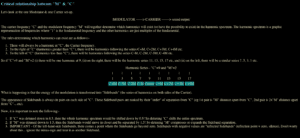
Calculating Sidebands from CM Ratios:
Upper and lower harmonic Sidebands get created at C+M, +2M, +3M etc as well as C-M, C-2M etc
Inharmonic and harmonic Sidebands
For example CM 2:5 creates upper sidebands at 7 and 12. 7 is an inharmonic but 12 is the 6th harmonic of 2. Sidebands can be inharmonic and harmonic.
Reflected Sidebands:
For example CM 2:5 creates lower sidebands at -3 and -10
Drop the minus and treat it as a positive number(acoustically this involves a phase inversion)Mathematically/C-M/
Using CM Ratios to Calculate Sidebands and HarmonicsCoinciding Sidebands:
Lower reflected sidebands can coincide with upper sidebands
Amplitudes get influenced by phase!
True for all N:1 ratios, as well as odd N:2 ratios
Every other ratio spaces its sidebands unevenly.
When is the Carrier also the lowest, fundamental pitch?
M is greater or equal to twice C
Or 1:1 ratio
This is also called the Normal Form of a ratio.
Reducing a Non Normal(when the carrier is not the fundamental)
Keep subtracting M from C (ignoring the minus sign) and always treat the result as the new C value
Keep doing it until the Carrier is the lowest pitch
Do this now
- Load Operator with two operators and a spectrum analyser.
- Set the modulator ratio to a whole number and raise the level slowly. Watch sidebands appear at even spacings.
- Now set the ratio to something non-integer and watch them go inharmonic.
Whole numbers sound musical, everything else sounds metallic. That is the entire rule of thumb.